Bridging The Gap Between Knowledge And Behavior: Rethinking Compliance
At a recent conference presentation, the speaker argued that AI is calling into question the very purpose of L&D departments. Instead of simply delivering training solutions, L&D could be transformed into an overall solution provider for companies. This raises profound questions about the future of L&D and the way in which training is created and deployed. Will learning become more contextualized and embedded in the “flow of work”? Perhaps content will be delivered in bite-sized chunks as microlearning? With the assistance of smart AI tools, Subject Matter Experts may take on more of a training role. And will the traditional model, where employees take training assigned to them via an LMS, soon be outdated?
A colleague’s response to this argument was that there will always be a need for compliance training. Why? Because legislation requires that employees be trained in certain topic areas on a regular basis. For this reason, compliance training is likely to be with us for some time, unlike other forms of training.
In this article, you’ll find…
Why Compliance Training Is Still Necessary
Having to complete compliance training is one of those tick-the-box activities that employees generally endure rather than enjoy. And because it’s imposed on employees, for many it conjures up thoughts of obligation, duty, and tedium. Through the practice of completing school homework from a young age, we have been conditioned to complete whatever compliance training is assigned to us. Even though compliance may have negative connotations, it is important. At every level in society—governments, organizations, clubs, schools, and families—we need rules to function well. Without compliance with these rules, dysfunction and chaos ensues.
It’s clear that compliance is important, but we need to remember that it only matters when the rules on which it is founded are meaningful and make sense. As much as we need to champion compliance, we need to promote a critical approach to the rules we comply with, and to let go of the ones that no longer serve us. However, that’s a topic for another day.
Putting time aside for training is something most of us do when we see a need for it; when we think it could be beneficial for our own development. When it’s something we are mandated to complete, in other words, compliance training, we tend to be less enthusiastic.
Rethinking Compliance Training: How Can We Make It More Appealing?
As compliance training is likely to be around for some time, what can we do to make it more appealing to learners, and to ensure that for the most part it’s a positive engaging learning experience? We could start by giving it a different name. A more encouraging term would be “essential training.” As an employee, if I were told to complete essential training, rather than compliance training, I would approach it with a more positive mindset. I would consider it something to help me do my job, rather than something to be endured.
Next, let’s consider the design and format of compliance training. Despite the vast array of design choices available to content creators, when it comes to compliance training, clients often impose design limitations to save time, money and effort. This is why compliance training often displays the following characteristics:
- Compliance-driven rather than learner-centered
- Text heavy and policy-focused
- Language style replicated from documents rather than adjusted for eLearning
- Linear and locked navigation (learners are forced to engage with every screen to progress through the training)
- Minimal interactivity
- Generic visuals for decorative rather than illustrative purposes
- One-size-fits-all approach rather than role-specific training
- Assessments typically test recall, rather than application
Not all compliance training displays these characteristics, but they are more commonly found in compliance training than other forms of training. Why is that? Why do companies not dedicate more time and money to creating engaging, targeted, and effective learning experiences? The answer, unfortunately, is that many organizations prioritize proof of completion over learning outcomes. Custom design and interactivity require more time and resources. Compliance teams often prefer safe, formal content to avoid misinterpretation. Sometimes, training is requested by functional experts rather than L&D professionals. Without knowing any better, they often opt for the cheaper, more cost-effective way of delivering training.
A Quiet Revolution In Compliance Training Design
Since the launch of ChatGPT, generative AI has been a catalyst for change in the workplace. Every organization has been forced to reflect on its processes, tools, and output. Though the initial hype about AI has subsided somewhat, there is still a quiet revolution at work that is forcing us all to reflect on every aspect of our work and to consider how we can leverage AI technology to do things faster and better.
Compliance training has not been immune to this quiet revolution. Reports online suggest that organizations have been questioning the effectiveness of traditional compliance training methods for some time, but generative AI appears to have accelerated a shift in design approaches. Immersive learning through the use of simulations, scenarios, Virtual Reality (VR), and gamified designs are gaining traction. Personalized, adapted training based on learners’ current knowledge and roles is becoming more commonplace. Microlearning in the form of short training modules that can be easily slotted into an employee’s work schedule is also gaining popularity. AI coaching agents are being used to deliver personalized tutoring and feedback on performance. Organizations are beginning to realize that compliance training, or even “essential” training, can be done better.
It has never been a more exciting time for content creators. The tools available today allow us to create rich, engaging, pedagogically sound learning experiences. With added AI capabilities, we can create content more cost-effectively and quickly. As a direct response to the traditional design approaches for compliance training listed above, let’s consider a more effective approach, rethinking compliance training:
- Make the content learner-centered
In other words, make it relevant and specific to the learner’s role and needs. - Only include content that helps to achieve the learning outcomes
Less is more, especially with eLearning. - Use a conversational writing style
To simulate an instructor-led delivery. - Allow learners to control their navigation through the training
- Incentivize completion using rewards
Rather than enforcement, as adult learners like to be in control. - Make the training interactive and challenging
Challenge is an essential ingredient in learning. - Use illustrative visuals that support the verbal content
Combining verbal content with supportive visuals enhances processing and recall. - Design application-based questions
Rather than simply testing information recall.
Here are more design choices to help make eLearning more engaging and effective:
- Focus on application of knowledge using task-based activities rather than transmitting knowledge; in other words, bridge the gap between knowledge and doing.
- Immerse the learner in situations or scenarios with characters they can relate to.
- Use examples and visuals that are relevant and meaningful to illustrate content.
- Make questions and activities part of the learning process rather than using them solely for assessment and use them to provide timely and constructive feedback that encourages reflection.
- To enhance recall and recognition, deliver content using one visual and one verbal channel whenever possible, and ensure that other channels do not compete.
Organizations are becoming more informed about the benefits of training that promotes effective work practices and behaviors. If employees don’t fully understand policies and how to apply them when carrying out their tasks, organizations are more vulnerable to fines, data loss and reputational damage. It is in their interest to embrace the educational technology available today as well as the proven best practices in Instructional Design theory to create immersive, engaging, challenging, and effective learning experiences that achieve learning objectives.
Rethinking Compliance Training With A Use Case: What To Do With Spillages
To conclude, let’s take a look at this following piece of training content that provides safety information on how to handle spillages in the foodservice industry. Two versions are provided; version A presents the steps of the safety procedure with an illustrative image. Version B goes a bit deeper by applying these two guidelines:
- Immerse the learner in situations or scenarios with characters they can relate to.
- Use examples and visuals that are relevant and meaningful to illustrate content.
Version A

Step 1: Stop and assess
- Identify the type of spill (water, oil, alcohol, food, chemicals)
- Check for immediate danger (hot liquids, broken glass)
Step 2: Secure the area
- Place a “Caution: Wet Floor” sign immediately.
- Inform staff to avoid the area.
Step 3: Clean up safely
- Wear appropriate PPE (gloves, nonslip shoes)
- Use correct cleaning materials (mop, absorbent pads for oil)
- Dispose of waste properly.
Step 4: Final check
- Ensure the floor is dry and safe before removing signage.
This information above is clear and easy to understand. However, it could be made more memorable by embedding it in a story. Let’s do that now with a short scenario.
Version B
(Restaurant scenario over 3 screens)
Screen 1
Tom works as a waiter in a busy bistro. During lunch service, Tom accidentally knocks over a jug of water near the kitchen entrance. He notices the spill but decides to “deal with it later” because he’s busy serving customers. In doing so, Tom:
- Fails to check for hazards like broken glass.
- Leaves the area unmarked and staff continue walking through the spill.
- Allows water to spread across the floor, creating a major slip risk.
Let’s see what happens next.
Screen 2
Minutes later…
Another server carrying hot dishes slips on the wet floor and hot food causes minor burns.
This incident, which Tom could have prevented, could lead to many consequences for the restaurant including delayed orders, customer complaints, compensation costs and possible fines.
Screen 3
Let’s rewind and consider what Tom should have done.
Step 1: Stop and assess
Tom checks the spill—no broken glass, just water. No immediate danger, but it’s a slip hazard.
Step 2: Secure the area
He grabs a “Caution: Wet Floor” sign and places it by the spill. Tom alerts staff to avoid the area.
Step 3: Clean up safely
Wearing nonslip shoes and gloves, Tom uses a mop and bucket to clear the water. He wrings out excess water and ensures the area is dry.
Step 4: Final check
Once the floor is completely dry, Tom removes the warning sign and confirms the area is safe with other staff.
Conclusion
The table below outlines the pros and cons of each version. Which version in your opinion is more likely to promote safe practices in the food industry?
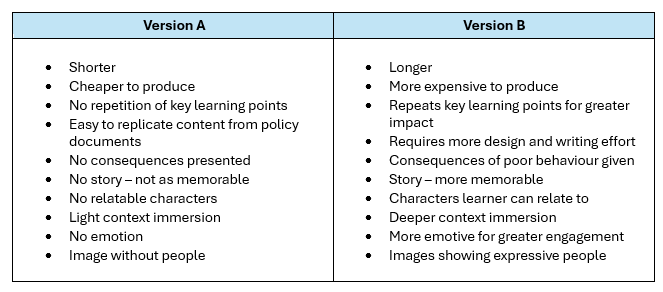
If companies want to promote good practices in the workplace, they need to invest in their employees by inspiring them rather than simply providing information, and by turning policies into practical principles they can understand and use to guide every decision. Essential training, if designed well, can promote a culture of good workplace practices, ethics and accountability.
Author’s Note:
- The ideas and content presented in this article are solely the work of the author and reflect her personal views. A GenAI tool was used by the author to generate copyright-free supporting images.
Further Reading:
- Paivio, Allan. Mental Representations: A Dual Coding Approach. Oxford: Oxford University Press, 1986.